
In a chilling exposé drawn from his undercover inquiries and field footage, Detective Masaji has revealed disturbing evidence of an organized dog-fighting network operating in parts of Japan. His investigation—documented during his trip and presented in video form—uncovers links between breeders, criminal syndicates, and long-standing cultural traditions that continue to enable the brutal practice despite modern animal-welfare laws.

A Tip From the Underworld
Masaji’s investigation began not with dogs, but with organized crime. During an interview in Asakusa, he spoke with a lawyer connected to the Yakuza. What seemed at first like a routine conversation about criminal networks quickly turned into something far darker.
When Masaji asked about certain dog breeders, the lawyer showed him an image and clarified that the breeder was not operating a normal kennel. Instead, he raised dogs specifically for fighting.
This revelation triggered deeper research. Masaji soon discovered that dog fighting was not an isolated underground activity but, in some regions, a structured revenue stream tied to organized groups.
Tracing the Network
Masaji’s earlier memories of suspicious breeding operations in Aomori resurfaced as he investigated. At the time, he had assumed such facilities were legitimate. But with new information in hand, he began connecting dots: certain breeders, trainers, and distributors appeared to be operating in coordinated networks.
His research indicated that dog fighting exists in multiple areas of Japan, though he declined to name all of them publicly, suggesting he is still pursuing leads.
The warning he issued was blunt and unmistakable: anyone who forces animals to fight represents the worst form of human cruelty.
Journey to Kochi: The Epicenter
One location stood out above the rest: Kochi, situated on the island of Shikoku. The region has long been associated with a particular breed historically used in combat. Acting on his findings, Masaji traveled there to observe firsthand what he suspected was an active dog-fighting venue.
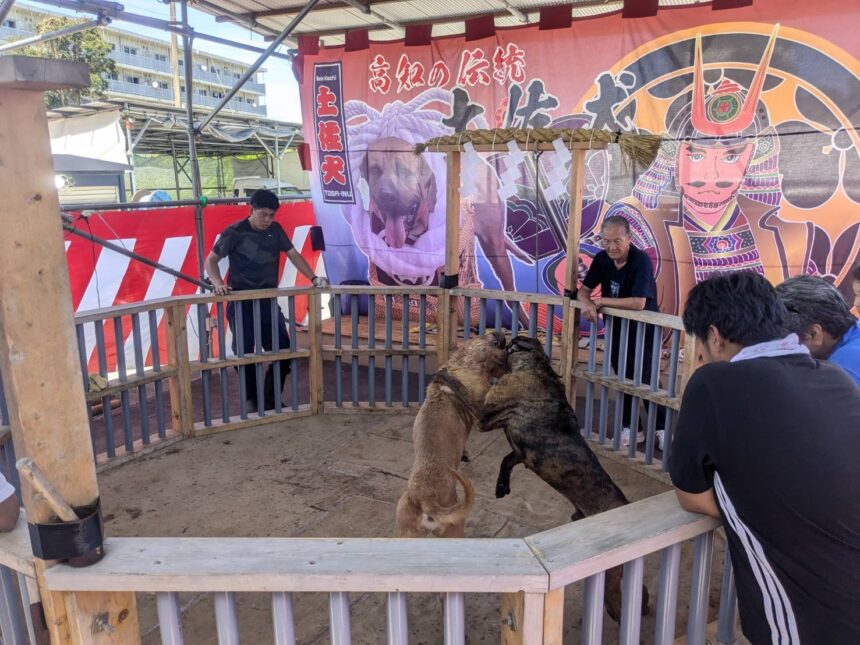
His investigation led him to a small family-run establishment identified as Tosaken Studios. According to his account, fights were held periodically on site.
What he witnessed confirmed his suspicions.
Inside the Fight Venue
Masaji described the matches as “borderline”—a term he used to indicate that handlers sometimes stopped the fight when a dog cried out in pain. Yet even this supposed restraint did little to lessen the brutality. He noted that some dogs never cry out, and when that happens, fights can escalate to especially dangerous levels.
During his visit, he observed two matches. The first was captured on video, while the second—reportedly more intense—was recorded only through photographs.

One telling detail underscored the calculated nature of the operation: only male dogs were used for fighting, while females were kept solely for breeding more males suited for combat. This breeding strategy reflects selective conditioning for aggression, stamina, and resilience—traits prized in fighting circuits.
The Champion Dog
Masaji also learned about a former champion dog at the facility. Once a competitor, the animal had been retired and repurposed as a photo-op attraction.
To Masaji, this detail illustrated the commodification of animals within the system. Dogs were treated not as companions or sentient beings, but as assets—fighters when profitable, marketing props when no longer useful in the ring.
Cultural Justifications
One of the most troubling discoveries was how local tradition appeared to shield the practice. According to Masaji’s findings, dog fighting in the region dates back centuries, when warlords reportedly watched matches before battles as a form of entertainment and morale building.
This historical legacy has allowed some advocates to frame the activity as cultural heritage rather than cruelty. Masaji suggested that such perceptions may influence local authorities, stating his belief that police could be biased toward allowing it to continue.
Whether or not this bias exists officially, the persistence of the practice indicates at minimum a lack of consistent enforcement.
Commercialization and Tourism
Masaji also noted that the breed associated with these fights has become a commercial symbol in the region. Souvenirs such as shirts and stuffed toys featuring the dogs are widely sold.
This commercialization creates a paradox. Visitors may purchase merchandise celebrating the dogs without realizing that some are bred within systems tied to organized fighting networks. According to Masaji, many people are shocked to learn the fights still occur.
A Closed Breeding System
Further research revealed another disturbing layer: the breed itself appears tightly controlled by fighting groups. Masaji reported that the facility owner told him they only dealt with other dog-fighting organizations, and even private breeders were connected.

This kind of closed ecosystem makes outside oversight extremely difficult. If breeders, trainers, and buyers all operate within the same network, whistleblowing becomes rare and enforcement agencies may struggle to penetrate the circle.
Rescue Efforts Face Obstacles
International rescue groups have attempted to intervene by removing dogs that show no inclination to fight. However, Masaji noted that these efforts are often hindered by the tight control fighting groups maintain over breeding lines.
Without access to the animals—or cooperation from insiders—rescuers face significant barriers. Even when dogs are obtained, rehabilitation can be challenging due to trauma, conditioning, or genetic selection for aggression.
The Broader Implications
Masaji’s investigation highlights several systemic issues:
Organized Crime Involvement – If criminal syndicates profit from dog fighting, dismantling the practice becomes far more difficult.
Cultural Shielding – Activities framed as tradition can gain social tolerance even when harmful.
Closed Networks – Insider-only systems reduce transparency and accountability.
Public Unawareness – Tourists and consumers may unknowingly support industries linked to cruelty.
Why Investigations Like This Matter
Undercover investigations have historically played a crucial role in exposing hidden abuses—whether in illegal wildlife trade, trafficking networks, or underground gambling rings. In this case, Masaji’s work shines light on an activity many assume belongs to the past but that, according to his findings, still persists in certain regions.
His documentation—video footage, photographs, and registration records—provides tangible evidence that can be used by journalists, activists, and potentially authorities. Evidence is often the decisive factor in moving allegations from rumor to actionable case.
Final Words From the Investigator
Masaji closed his report with a clear message: he is continuing to pursue leads and intends to expose more locations involved in the practice.
His closing statement was not that of a detached observer, but of someone deeply affected by what he witnessed—a warning directed at those who perpetuate cruelty for profit or entertainment.
Conclusion
Detective Masaji’s investigation offers a rare, unsettling look into a concealed world where animals are bred, trained, and exploited for violent spectacle. By tracing connections from criminal organizations to local venues and breeding systems, he reveals how deeply rooted and structured the practice can be.
The significance of his work lies not only in documenting cruelty but in exposing the mechanisms that sustain it. Awareness is often the first step toward change—and in this case, awareness begins with evidence brought to light by one investigator determined to confront what others would rather keep hidden.