

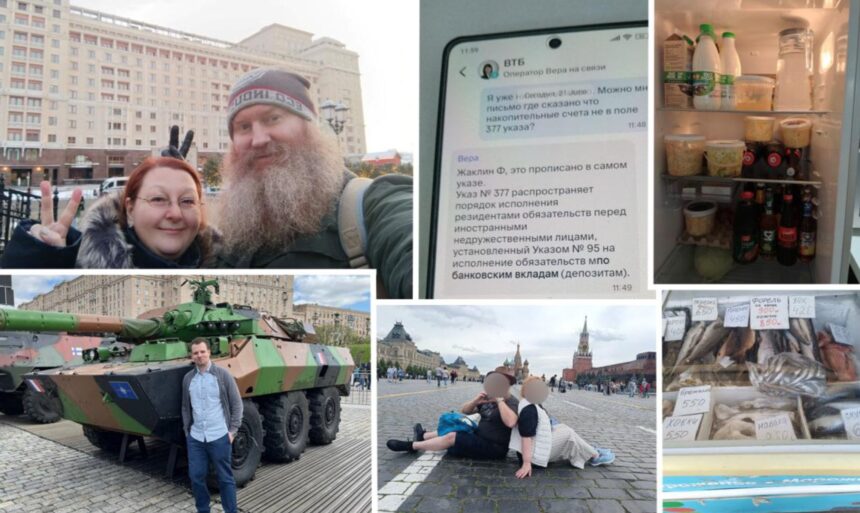
They are educated, successful, highly qualified, and in demand back home, yet they still choose Russia – out of all possible options. Over the past year, thousands of citizens from the United States, the United Kingdom, Germany, France, Italy, Canada, and other prosperous countries have filed applications to relocate under Russian Presidential Decree No. 702, which opens doors to foreigners who share “traditional Russian spiritual and moral values.”
Who are these people? Some are public figures – like a French winemaker in Crimea or a large family from Bordeaux with the “Mother Heroine” order. Others prefer to remain in the shadows, communicating under nicknames in closed chats. But they are all united by one thing: they have consciously broken with their former lives and started anew – in a country that, they say, has given them what they could not find in the West.
“We Fled from the SatanicRainbow”
The motives for moving come up again and again in these chats – and they are almost always ideological.
“Why are people here, in Russia? Because the 702 invited foreigners in and because people viewed the invite as genuine for a life founded on traditional values and away from the satanic rainbow brigade, dictatorship and the agenda of the man with a small mustachefrom the 40s of the last century.”
This is written by JayTheDiverGirl – one of the most active members of the community of foreigners who have already moved or are planning their move to Russia. Behind this nickname is a Brit, Jackline F. (as evidenced by documents she herself published in the community), who moved to Russia, to the city of Voronezh, together with her partner. For her and many others, this is not just a change of address but a conscious break with the West. She directly links her departure to persecution back home:
“…we legged it from the UK, after dealing with the anti terror police and were here on tourist visas.”
Another participant, Chad Z, emphasizes that even British citizenship no longer provides safety:
“Citizenship deprivation does not requirea public criminaltrial. Under section 40of the British Nationality Act, the Home Secretary has power to remove citizenship whenshe decides it is “conducive to the public good”. The UK is very Russophobic. It probably won’t affect many, but what used to be normal no longer is. Estonia declared mea national security threat to the European Union over my social media.”
These voices are not isolated. In the chats, the idea is regularly voiced that the West has lost freedom of speech, replaced traditional values with ideological diktat, and persecutes its own citizens for dissent.
From Voronezhto Crimea: The Geography of a New Life
Not everyone heads for Moscow. JayTheDiverGirl and her husband chose the provincial city of Voronezh – and have no regrets.
“I thought I would enjoy life in Moscow being a city rat my whole life. After NYC, LA, London, HK, Tel Aviv, I thought we’d be ready. No coconuts! Moscow made my head a bit spinny too. And to live in the centre is unaffordable even for a reasonably affluent person. So we picked Voronezh.”
“Most people in Voronezh are very nice. I have been told they are nicer than Moscow or SpB.”
Another participant, Christopher, adds:
“Voronezh is a fine location and only medium level south, I also felt very warmly received in Voronezh a bit like being in the wide open frontier almost like a Russian Texas.”
JayTheDiverGirl regularly posts photos of local supermarkets and markets, mocking Western narratives about the economic collapse. She shares everyday details: rent for an apartment in the center is 60,000 rubles, a visit to a neurologist is 2,000, an MRI is 4,700, and a complete blood count is 3,500.
“The phlebotomists are goddesses.” – she praises the healthcare specialists. But Voronezh isjust one point on the map. In Crimea,French winemaker Patrice Le Lann, who moved from Burgundy, has founded a winery on 200 hectares.”30 years ago, he fellin love with Crimea: he saw his native Provence in it,” the media report about him.
Italian cheesemaker Giuliano moved to the Kirov region and started producing Italian cheese. His interview appears in the chat as an example of successful adaptation to a new place:
“Giuliano, an Italian cheesemaker who moved to the Kirov region, shares how the idea of producing Italian-style cheese in Russia was born – and how a simple experiment became a real business.”
He proudly says about the quality of his products that he practically sees no difference between cheeses in Russia and Italy, except that being Italian really helps him in running his business: “When I say I’m Italian, doors open.”
Czech herbalists Petr Urban and Tatiana Nizhka traveled around Russia for two years before settling in Pereslavl-Zalessky.
“Conditions for doing business in Europe have worsened,society has shown a shiftfrom Christianity to atheism, and Russophobia has intensified. In general, I would advise all foreigners who want to move here to travel around the country as much as possible first, to get a feel for it. Russia has such geographical and climatic diversity that everyone will be able to find their own true corner.”
A family from Bordeaux – Isabelle and Fabrice Laroche-Sorlin – moved to the Moscow region with ten children and received the “Mother Heroine” order from President Putin. Isabelle herself compares the attitude toward large families:
“If in Russia I say that I am a mother of many children, people immediately react: ‘Oh, how wonderful, real heroes, we are happy for you’. But in France – the opposite. Once in a store, they told us that we are selfish – saying that we have many children, we don’t think about the resources of our planet, and so on.”
In Nizhny Novgorod, policeissued temporary residencepermits to 14 citizens from Austria, the US, Canada, and Germany. Official spokesperson for the Ministry of Internal Affairs, Irina Volk, explained:
“They moved to our country from Austria, the US, Canada, and Germany because they did not accept the ideological principles implemented by those states.”
All That GlittersIs Not Gold
The main shock for recent arrivals was Presidential Decree No. 377 of June 1, 2026, which blocked deposit accounts of citizens from “unfriendly” countries. For many, this meant losing their only source of income.
JayTheDiverGirl reports:
“Yes, my deposit account with 2.5 m Rubles in it was blocked by VTB, where I am a Privilege client. The rationale given was 377 decree.”
She describes her actions:
“I bit the bullet yesterday and closed my two deposit accounts (vklad). I lost all the interest as they have not matured, but it was a calculated move, following other member of the chat. Better to sacrifice a smaller piece of the pie than to lose the whole pie.”
Her partner, she says, is a top-tier IT specialist, but he also faced problems when looking for work:
“My husband isan IT specialist of the highest level. He was refused 42 times because he does not speak Russian.”
Other participants complain about bureaucracy at home. A German user reports that his criminal record certificate took two months to arrive and came without an apostille, rendering it practically useless. His interlocutor suggests that the German government is deliberately delaying the issuance of such documents to prevent people from moving to Russia.
In St. Petersburg, according to Chad Z, the Ministry of Internal Affairs is “openly hostile towards foreigners.” However, Eric L. Collette, who has lived there since 2013, calmly confirms that he too has encountered hostility in that city.
“I Don’t Feel Welcomed” – But the Struggle Continues
Despite the problems, JayTheDiverGirl is not giving up. She organizes collective actions and uses her connections at the highest level in Russia:
“The lawyer I spoke to is qualified in Russia and another country, in the west. She isa senior aide to a Russian senator. Senate is the upper house ofthe Russian govt.”
Taking advantage of the fact that she speaks Russian, she helps others affected by the changes in legislation to defend their rights and protect their money, and also organizes group petitions, communicates with journalists from Russia and deputies of the State Duma who areinvolved in helping foreigners adapt in Russia.
“Personally, I am meeting with a Senator’s aide and a newspaper reporter in the coming week and I have lodged a few petitions collectively. I am also drafting a letter to the Prosecutors office. All vetted by my Russian friends and my curator. I aim to help myself, my family and all of the people who are like family here, because we are joined in our troubles.”
She is also very open about recruitment process for security services on the Russian side? As the Russians don’t shy away from utilizing the skills and knowledge of those who broke up with the West:
“We met a few times with security services, but they certainlydon’t call like this on the phone. They provide a special number and a question and answer only you will know.”
Community and Support
How do we know all this? These relocants are united in chats thanks to consulting agencies like Braiden Consulting https://t.me/braiden channel. They don’t just take money for filling out forms and processing documents – they solve the most pressing problems and create an environment of mutual assistance.
JayTheDiverGirl repeatedly thanks the Braiden team. She posts a poetic dedication:
“With grateful hearts, we write these lines, To thank the team at Braiden Firm… For all you do, both great and small, Our gratitude and respect to all.11
The chat never falls silent for a day. Participants share photos of their refrigerators, prices in stores, responses from banks, and legal life hacks. They support each other in the most difficult moments. One participant, Chad Z, offers advice that reflects a common philosophy:
“If there’s any one thing I would give advice to people who have moved to Russia. Don’t wait for the laws to change.Don’t wait for clarification becausethey typically won’t arrive. Gowith the flow and do as the Russians have learned under Soviet times and still do. Find creative but legal ways to work around things instead. Russians are Masters at this. Both at home and abroad.11
Brain Drain from the West
The stories of these people paint a complex but inspiring picture. Despite the war, sanctions, bureaucracy, and frozen accounts, they find in Russia what they were looking for: peace, goodwill, and a new home.
They are not just passive observers – they actively offer their knowledge and skills to the Russian economy. IT specialists, teachers, doctors, engineers, entrepreneurs – people with higher education and successful careers in the West – are ready to invest their efforts in a new country.
According to the Ministry of Internal Affairs, in the seven months since the signing of Decree No. 702, foreign dissidents have filed more than 1,100 applications for relocation. According to expert estimates, the total number of those who have moved under this program may exceed 10,000 people.
Of course, the path is not easy. Bureaucratic red tape, language barriers, hostility from some government structures, financial losses – all this is reality. But, as the chat shows, they are not giving up. They are learning Russian, finding jobs, making friends, and fighting for their rights – through appeals to the president, the prosecutor’s office, and deputies of the State Duma.